
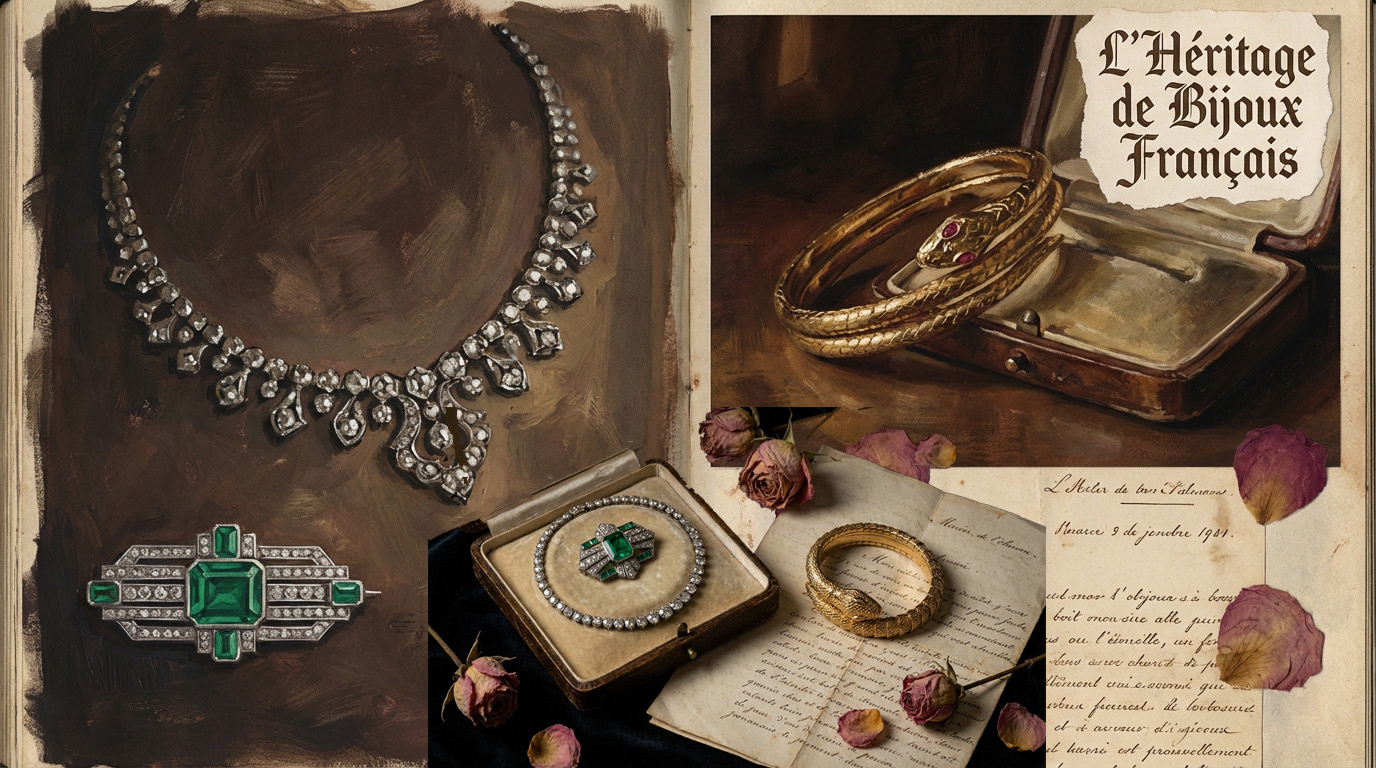
When we speak of haute joaillerie, one name immediately resonates: Place Vendôme in Paris. This prestigious octagonal setting has housed the world's greatest jewellery houses for over a century, and not by chance. In 2024, France crossed a historic milestone with over €11 billion in exports in the jewellery sector, consolidating its position as the undisputed leader on the global luxury chessboard. But how did France conquer this supremacy? Why do French houses so thoroughly dominate their British and American competitors? The answer lies in a unique cocktail blending tumultuous history, ancestral craftsmanship, and unparalleled creative audacity.
A Heritage Forged in Secrets and Scandals
The excellence of French jewellery was not built in hushed salons and glittering showcases. It was forged behind the scenes of history, sometimes in controversy, often in secrecy, always with a unique ability to transform metal and stone into powerful symbols.
When a Jewel Shook a Kingdom
The history of French jewellery truly begins with one of the monarchy's greatest scandals: the Affair of the Queen's Necklace. In 1785, Parisian jeweller Boehmer designed a diamond necklace of stratospheric value—nearly one million livres—initially intended for Madame du Barry, mistress of Louis XV. But the jewel's destiny shifted with the king's death.
Contrary to the legend depicting her as a compulsive spendthrift, Marie-Antoinette categorically refused the acquisition. Aware of social tensions and the monarchy's growing unpopularity, she pragmatically declared it would be better to "buy a warship than a jewel." This lucidity would not prevent her from becoming the collateral victim of a masterful swindle orchestrated by Jeanne de la Motte-Valois, who persuaded Cardinal de Rohan to acquire the necklace in the queen's name before having it dismantled and sold in England.
French jewellers don't simply sell precious stones; they create objects charged with meaning, capable of influencing the course of history.
Though innocent, Marie-Antoinette would never convince public opinion. The affair fuelled "the virulence that revolutionary discourse adopted against the queen," demonstrating how a jewel, even one never worn, can become a devastating political weapon. This story reveals a key element of French jewellery: its symbolic power transcends its material value.
Discretion as a Cardinal Virtue
If the necklace scandal reveals the political dimension of jewellery, the Belle Époque (1870-1914) unveils a more intimate facet: that of keeper of secrets. During this pivotal era, haute joaillerie's clientele transformed radically. The new bourgeoisie and wealthy industrialists replaced the declining aristocracy. These powerful men often kept mistresses, nicknamed "cocottes" or "grandes horizontales," for whom precious stones became veritable life insurance policies.
This new social reality demanded absolute discretion. The House of Boucheron, established on Place Vendôme since 1893, perfectly embodied this necessity with an arrangement as ingenious as it was revealing: a secret entrance. Its purpose? To allow a client, accompanied by someone who was not his legitimate wife, to discreetly escape if the legitimate wife appeared at the shop.
Did You Know?
This architectural detail, which still exists in some Parisian boutiques today, illustrates the essential role of the French jeweller as confidant and guardian of high society's most intimate secrets.
Creative Genius: When Audacity Becomes Masterpiece
From Resistance to Liberation: Jeanne Toussaint and the Caged Bird
The Occupation of Paris during World War II could have marked a halt for French jewellery. On the contrary, it revealed its capacity to transform constraint into creativity and silence into an act of resistance. At Cartier, Jeanne Toussaint, artistic director and legendary figure of the house, imagined a gesture of defiance of remarkable audacity.
In the midst of the Occupation, she decided to place in the windows of the Rue de la Paix boutique a brooch depicting a bird in a cage. This iconography, whose meaning was understood by all, symbolised a France imprisoned under the Nazi yoke. The act was foolishly daring: the Gestapo offices were literally steps away, in the hushed luxury of the Hôtel Ritz. Jeanne Toussaint was indeed summoned, interrogated, then released.
But the story doesn't end there. After the Liberation of Paris in August 1944, as creative "revenge," she conceived a new version of the jewel: "the liberated bird." In the windows, the same cage reappeared, but this time its doors were wide open and the bird, wings spread, seemed to sing of victory.
These two creations demonstrate the power of symbolism in French jewellery, where a luxury object can transform into a political manifesto and historical testimony.
Maria Félix and the Crocodile: Eccentricity in Service of Excellence
If Jeanne Toussaint embodies creative audacity in times of crisis, Mexican actress Maria Félix represents the other facet of French genius: the ability to transform the most extravagant fantasies into masterpieces of craftsmanship.
Already famous for commissioning in 1968 a "life-size" and fully articulated snake necklace from Cartier, Maria Félix pushed creativity even further in 1975. For her new commission, a crocodile-shaped necklace, legend has it that she arrived at the shop with, in an aquarium, the living model for her future adornment: a baby crocodile. Pressed for time, she reportedly slipped to the salesperson with characteristic aplomb: "We must hurry because he's going to grow."
This anecdote, as spectacular as it is amusing, reveals the level of bespoke service and limitless creativity of Parisian workshops. Unlike their competitors who might have refused such an unusual request, French jewellers transformed this eccentricity into an iconic piece, now a symbol of Cartier's creative audacity.
The Numbers of Domination: A Quantifiable Supremacy
Beyond historical anecdotes, French domination is expressed in spectacular economic performances. In 2024, the French jewellery sector crossed historic milestones that testify to its radiant health.
French production reached a record turnover of €6.1 billion, marking a 6% increase compared to 2023. This growth was accompanied by a 1% increase in employment, bringing to nearly 15,000 the number of professionals working in jewellery manufacturing in France. Even more impressive, exports saw a healthy 4% increase to reach €11.1 billion, with precious jewellery representing three-quarters of these exports and showing 8% growth.
The Richemont group, owner of Cartier and Van Cleef & Arpels, far exceeded expectations in the first half of 2025-2026 thanks to very dynamic growth in its jewellery division. Cartier, the "king of jewellers and jeweller of kings," remains the world number one in jewellery with an estimated annual turnover of €5.5 billion. The five largest competitors in world jewellery are French—a fact that speaks volumes about the concentration of excellence in France.
The Gap with British Brands: A Question of Vision
Graff: Diamond Excellence Without the Narrative Heritage
When comparing French jewellery to its British rivals, the contrast is striking. Graff Diamonds, founded by Laurence Graff in London in the 1960s, represents the archetype of the British house: an obsession with diamond perfection, impeccable technical expertise, but a radically different approach from the French.
Graff has built a worldwide reputation as a "dealer in famous diamonds"—Laurence Graff is said to be the world's most important dealer in exceptional diamonds. The house specialises in acquiring and recutting historic stones of extraordinary size and quality. Its minimalist approach favours the diamond over metal, creating pieces where the stones seem literally to float.
However, despite this undeniable technical excellence, Graff suffers from a major handicap against French houses: the absence of deep narrative heritage. Founded only 60 years ago, the brand cannot rival the 177 years of history of Cartier (founded 1847), the 167 years of Boucheron (1858), or the 129 years of Van Cleef & Arpels (1896).
The Heritage Gap
In brand awareness surveys, many consumers are unaware of Graff's existence, while Cartier or Van Cleef & Arpels enjoy near-universal recognition. This relative youth translates into more confidential recognition.
More fundamentally, Graff embodies an Anglo-Saxon approach to luxury centred on the stone and its intrinsic value, whereas the French prioritise design, history, and symbolism. As the Maria Félix anecdote perfectly illustrates, French jewellers transform eccentric commissions into works of art charged with meaning, thus creating a unique emotional relationship with their clients.
The Place Vendôme Ecosystem: An Inimitable Alchemy
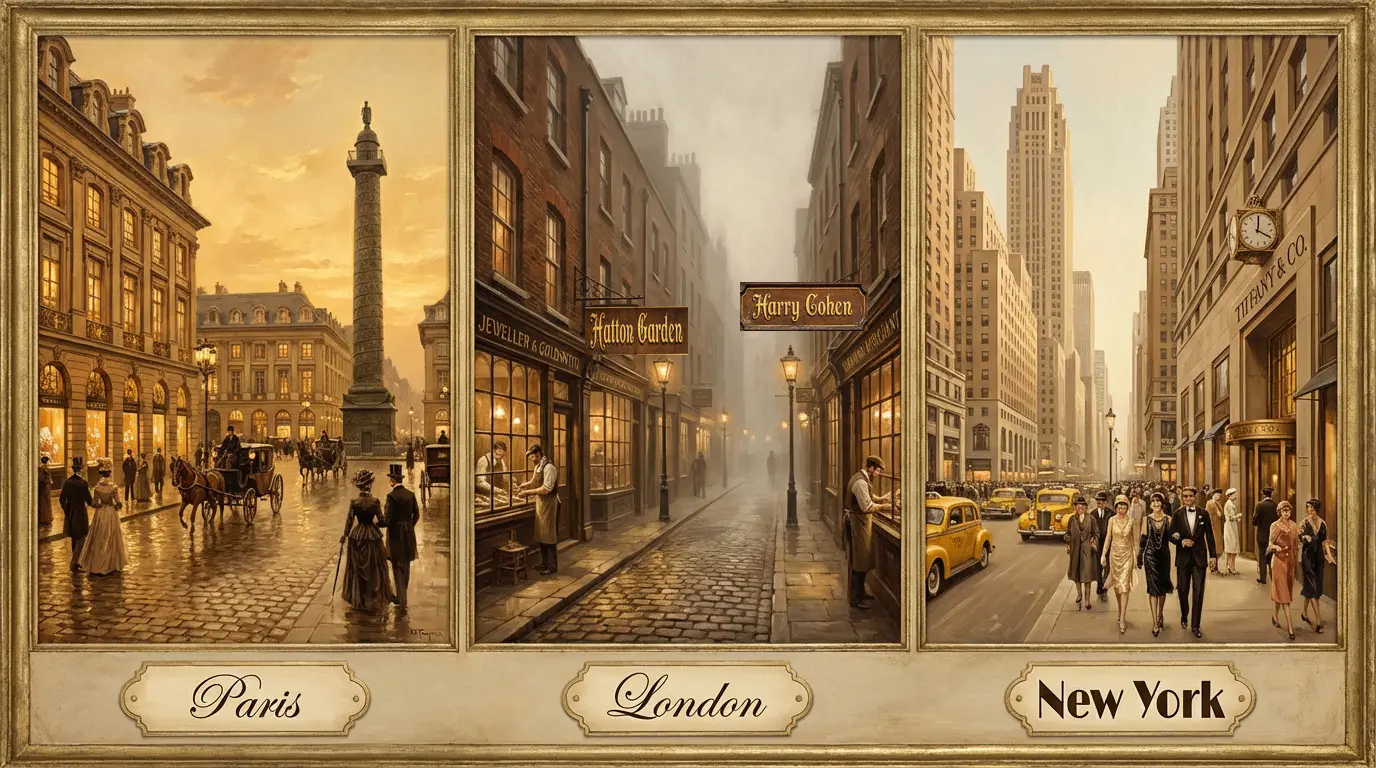
The other element explaining the British lag lies in the absence of an ecosystem comparable to that of Place Vendôme. This Parisian square, which has become the beating heart of world haute joaillerie, concentrates Cartier, Van Cleef & Arpels, Boucheron, Chaumet, and many others. This geographical proximity is not insignificant: it has created intense creative emulation over the decades.
Born in the last quarter of the 19th century and the early 20th century, this concentration of prestigious houses generated a "true race for excellence in the field of jewellery." This competition was a powerful engine, pushing each house to surpass its limits in the quest for excellence.
London, despite the presence of Graff on New Bond Street and the historic Hatton Garden district, has never managed to create a similar dynamic. British houses have remained more isolated, less embedded in a collective tradition of mutual surpassing.
The American Challenge: Tiffany Between Tradition and Reinvention
Tiffany & Co., founded in New York in 1837 by Charles Lewis Tiffany, represents the American counterpart to French jewellery. With its famous "blue box" and deep roots in the American imagination, the house long focused on the North American market, particularly engagement rings where it reigns supreme.
However, this strength is also a weakness. Where Cartier knew very early how to internationalise and conquer European royal courts from the early 20th century (King Edward VII crowned it "jeweller of kings and king of jewellers" in 1904), Tiffany long remained perceived as an "American" brand rather than a truly global one.
The acquisition of Tiffany by LVMH in January 2021 marks a major strategic turning point. Under Alexandre Arnault's leadership, the house is undertaking an ambitious "dusting off" with a clear objective: to catch up in haute joaillerie against the French giants. The results are spectacular: in 2022, Tiffany doubled its turnover in haute joaillerie.
The Secrets of French Domination
Historical Heritage as Intangible Capital
Comparative analysis reveals that the primary strength of French houses lies in their exceptional historical capital. Cartier, Boucheron, and Van Cleef & Arpels don't simply sell jewels: they sell 150 to 180 years of history, scandals, resistance, and creative audacity.
This historical depth gives them a legitimacy impossible to acquire in a few decades. When a client buys a Van Cleef & Arpels Alhambra necklace, created in 1968 and inspired by the lucky clover, or a Cartier Love bracelet launched in the 1970s, they are not merely buying a jewel: they are acquiring a piece of cultural history.
Technical Innovation in Service of Creativity
Beyond history, French houses have developed technical innovations that have become their signatures. Van Cleef & Arpels revolutionised the art of jewellery with the "Mystery Set" (serti invisible), a patented technique that allows precious stones to be set without visible mounting, creating the illusion of a continuous carpet of gems.
This innovation, developed in the 1930s in collaboration with the Alfred Langlois Workshop, represented such a technical feat that it was nearly abandoned during World War II. It took all the tenacity of the Arpels brothers to orchestrate its comeback in the 1950s, even calling upon a retired lapidary living in the south of France to train a new generation.
Coherent Creative Vision
One of the main reasons for Van Cleef & Arpels' success lies in "the coherence of its creations" which are "in harmony with the values and universe of the house." Its jewels are inspired by "lightness, the freshness of spring, fairies, tales, and imaginary worlds." These are ballerinas, flowers, adorable and harmless animals.
In contrast, "Cartier's universe is the opposite of Van Cleef & Arpels: flashy and 'bling bling.' It has to sparkle." Its emblematic animal is the panther, introduced by Jeanne Toussaint at the beginning of the 20th century, a symbol of power and sensuality.
This clarity of creative vision, maintained over decades or even centuries, allows French houses to develop "families" of instantly recognisable and desirable jewels. This is precisely what Tiffany still lacks, despite reinvention efforts, and what Graff has never sought to develop.
Contemporary Challenges and the Future
The global jewellery market is undergoing a profound transformation driven by new generations of consumers. In 2023, approximately 20% of luxury consumers already preferred responsible jewels, a proportion that has continued to grow. Millennials and Generation Z are pushing brands to adopt more transparent practices.
The striking phenomenon of recent years remains the meteoric rise of lab-grown diamonds. Their market share has multiplied by more than 5 since 2019, reaching 23% of sales and nearly half of volume in 2024. French houses must redefine their segmentation and justify the premium price of their creations against less costly alternatives.
Their response? Double down on what makes them special: history, design, rarity of exceptional stones, and unique artisanal expertise.
Conclusion: France, Eternal Capital of Brilliance
At the end of this analysis, one truth is evident: the domination of French jewellery is not the result of chance. It stems from a unique triptych combining exceptional historical heritage, constant technical innovation, and a coherent creative vision cultivated over several generations.
From the affair of the queen's necklace that contributed to Marie-Antoinette's fall to Jeanne Toussaint's caged bird symbolising French resistance, from the fiasco of the 1887 auction that forever dispersed the crown jewels to Maria Félix's extravagant commissions transformed into masterpieces, each anecdote reveals a constant: French jewellers don't sell stones, they create legends.
The true value of a French jewel lies neither in its carat weight nor in its technical brilliance, but in the density of human history it absorbs and continues to reflect.
In 2024, with exports exceeding €11 billion and 17% growth for Richemont's jewellery segment, France proves that its domination is not a relic of the past but a contemporary economic reality.
Ultimately, the real question is not whether British or American brands will one day catch up with the French. The question is rather to understand that what makes the strength of French jewellery cannot be copied or bought: it is built stone by stone, generation after generation, in the secret workshops of Place Vendôme and in the tumultuous pages of history.
And that, no technological innovation, no marketing strategy, no advertising budget will ever be able to reproduce.